

Hardware Aesthetics & Practical Guide: The Ultimate Door Knob Guide & Selection Manual by FLIRABBIT
Door knobs are among the most common and familiar architectural hardware items in any home. However, choosing the right set of door knobs is often far more complex than simply picking a beautiful design. Factors such as the underlying lock mechanism, backset, door thickness, room type, and surface finishes directly determine whether the installed door operates smoothly and stands the test of time.
The Golden Rule of Hardware Selection: Determine the mechanical structure first, then select the aesthetic style. Once you clarify what type of lock body your door requires (such as a tubular latch, mortice lock, bathroom lock, or high-security exterior lock), the remaining selection process becomes simple and precise.
I. What is a Door Knob?
In traditional architectural ironmongery parlance, a door knob refers to a round, spherical, oval, or similarly geometric grip that is rotated to operate a latch or lock.
It is crucial to note that traditional door knobs do not contain an internal locking mechanism themselves. Instead, they rely on a spindle—a metal bar passing through the door—to transfer the rotational force to the latch or lock body installed inside or on the surface of the door, thereby retracting the latch bolt.
Therefore, a door should be viewed as a complete, integrated system: the knob, spindle, lock body, cylinder, escutcheon (keyhole cover), and strike plate (keep) must work together in perfect harmony. Forcing an exquisite door knob onto an incompatible, worn-out, or broken lock body results in stiff rotation, failure to spring back, or a knob that sits too close to the frame, leading to scraped knuckles.
II. Mechanical Structure First
Before diving into materials and designs, you must first outline the practical function and usage scenario of the door. Different rooms have vastly distinct requirements for privacy and security:
- Standard Passage Doors (e.g., living rooms, hallways): Only require a simple tubular latch or mortice latch with no locking function.
- Bedrooms or Studies: May require a lock body with a key-locking function, such as a mortice sash lock.
- Bathrooms and WCs: A dedicated bathroom mortice lock paired with a separate turn and release mechanism is highly recommended. The greatest advantage of this setup is safety; in an emergency, someone outside can easily unlock the door using a coin or a flathead screwdriver. Entrance Doors: Demand the highest level of security. The door knob serves merely as an auxiliary pull and turn piece, while the core anti-theft performance should be provided by a high-security mortice lock complying with national security standards (such as a British Standard 5-lever lock body).

III. Balancing Minimalism and Aesthetics: Privacy Pin Door Knobs
In modern high-end residential and "Quiet Luxury" interior designs, an incredibly popular solution for bedrooms and bathrooms—beyond the traditional separate turn-and-release mechanism—is thePrivacy Pin Door Knob.
1. Mechanical Principle & Daily Operation
This clever design seamlessly integrates the privacy locking mechanism directly into the door knob's rose plate (backplate).
Interior Locking: On the inner rose plate, there is a subtle, elegant metal pin. When inside and seeking privacy, a simple push or clockwise twist of the pin engages the lock, disconnecting or blocking the exterior knob's linkage. This leaves the outside knob spinning freely or locked in place, ensuring privacy.
Panic-Free Auto-Unlock (Egress Function): When exiting the room, simply turn the interior knob normally. The internal mechanism instantly snaps the privacy pin back to its original position, unlocking the door automatically. This "one-step exit" design provides exceptional efficiency and safety in emergencies like fires.
2. Emergency Release Mechanism
To prevent children from accidentally locking themselves inside or to assist an elderly person facing a medical emergency in a bathroom, privacy pin knobs feature a discreet emergency release hole on the exterior rose plate. In an emergency, an outsider can easily pop the pin back into the unlocked position using a paperclip, pin, or specialized tool without damaging the door panel, guaranteeing absolute peace of mind.

3. Aesthetic Appeal & Installation Benefits
Pure Minimalistic Visuals: Traditional bathroom locks require an extra hole drilled into the door face to accommodate the separate turn-and-release thumbturn, which can disrupt the clean, continuous vertical lines of a premium wooden door. The privacy pin houses the function entirely within the rose plate, eliminating cluttered hardware and letting pure design shine.
Simplified Installation: For installers, it only requires drilling a single standard bore hole for the knob. This dramatically reduces the margin of error or alignment mistakes often associated with dual-bore prep.
In modern high-end residential and 'Quiet Luxury' interior designs, FLIRABBIT’s Privacy Pin Door Knobs offer an incredibly popular solution for bedrooms and bathrooms—seamlessly combining vintage aesthetic rosettes with clean, keyless privacy mechanisms.
IV. Privacy Pin vs. Mortice vs. Rim Lock Door Knobs
These are the three most easily confused and commonly mis-purchased concepts when selecting and replacing door knobs:
|
Comparison Dimension |
Privacy Door Knobs with Locking Pin |
Mortice Door Knobs |
Rim Lock Door Knobs |
|
Installation Position |
The lock body is completely embedded into a slot cut into the edge of the door, with an installation method similar to standard mortice locks. |
The lock body is completely morticed (recessed) into a slot cut into the edge of the door. |
The lock body is mounted directly onto the face of the door with screws (fully visible). |
|
Aesthetic Features |
The rose plate on the inner side features a privacy locking pin, which locks when pressed or turned; the corresponding position on the outer side has an emergency release hole. |
The knobs on both sides of the door are fixed directly to the timber face using rose plates. |
The knob on the lock side sits directly against the rim lock casing, while the knob on the opposite side fixes to the door via a rose plate. |
|
Applicable Scenarios |
Modern interior spaces requiring privacy but not high-security theft prevention, most commonly used for bathrooms and bedrooms. |
Modern internal doors and the vast majority of standard newly installed timber doors. |
Period property restorations, rustic country styles, and cottage-style interiors. |
|
Hardware Component |
Additionally equipped with a locking pin, and the rose plate has a specific pin hole; typically requires a special spindle or a linked lock body that supports privacy functionality. |
Equipped with standard rose plates and a symmetrical spindle. |
Has specific requirements for spindle length and rose design, often featuring an adjustable loose rose. |
 |
|
|
|
Privacy Pin Door Knob |
Mortice Door Knob |
Rim Lock Door Knob |


V. Sprung vs. Unsprung
Depending on whether there is an assisted spring-back mechanism inside, door knobs are divided into two categories:
1. Sprung Door Knobs: These feature a built-in coil spring behind the rose plate or within the knob assembly. When you turn and release the knob, its internal spring quickly snaps it back to its original horizontal or neutral position. If your existing latch mechanism is old, has weakened tension, or is a lightweight latch, sprung knobs provide a firm, snappy, and responsive tactile experience.
2. Unsprung Door Knobs: Many traditional door knobs made of solid wood, solid brass, or cast iron are completely unsprung. They rely entirely on the spring tension inside the lock body to return the knob to center. If you purchase traditional unsprung knobs, you must pair them with a heavy-duty latch or lock. Pairing them with a cheap or weak lightweight latch will cause the knobs to sag or fail to return to position after being rotated.
VI. Crucial Measurement: Backset & Hand Clearance
When replacing traditional lever handles with spherical or round door knobs, the backset is the most common pitfall.
What is the Backset?
It is the horizontal distance from the edge of the door panel to the exact center of the spindle hole.
Why do door knobs require a longer backset?
Traditional lever handles naturally extend your hand's grip position inward, far away from the door frame. Conversely, a round door knob requires your entire palm to wrap around it to rotate, meaning your fingers and knuckles flare out around the perimeter of the knob.
If the backset is too short (such as the standard 45mm or 57mm latches common in modern standard configurations), the knob sits too close to the door edge. When closing or opening the door, your knuckles and the back of your hand are highly susceptible to brutally smashing or scraping against the door stop or frame, resulting in a frustrating daily user experience.
- Buying Advice: For doors featuring round knobs, 64mm (2½ inches) is the absolute bare minimum. Where space and door structure permit, it is strongly advised to use a 76mm (3 inches) or even 102mm (4 inches) long backset lock body. This not only provides ample, comfortable clearance for your hand, but it also aligns the knob closer to the center of the door stile, which perfectly complements the balanced aesthetic proportions of premium, classic doors.
VII. Common Materials & Finishes
The material of a door knob dictates its tactile feel, durability, and the way its luster evolves over time:
- Wooden Knobs: Commonly available in rosewood or ebonised black styles, offering a warm, organic touch. They are perfectly suited for Victorian and Edwardian period property restorations. Wooden knobs are ideal for interiors and should be avoided on exterior doors fully exposed to rain and sun.
- Brass Knobs: An incredibly classic metallic option.
Polished Brass: If left unlacquered, it will naturally oxidize through air contact and handling, developing a unique, deep character known as a "living finish".
Antique Brass / Aged Brass: Arrives from the factory with an elegant, darkened patina, offering an instant vintage charm without the wait.
- Cast Iron Knobs: Heavy and rugged, bringing a distinct industrial or rustic black ironmongery character. Because iron can rust in humid environments, periodic waxing is required when used in bathrooms or outdoors, unless you choose products treated with specialized rust-resistant coatings (like Armor-Coat).
- Ceramic & Porcelain Knobs: Feature a smooth, glazed luster, frequently utilized in classic country, farmhouse, or French elegant interior styles.
VIII. Period Architecture and Style-Specific Hardware Considerations
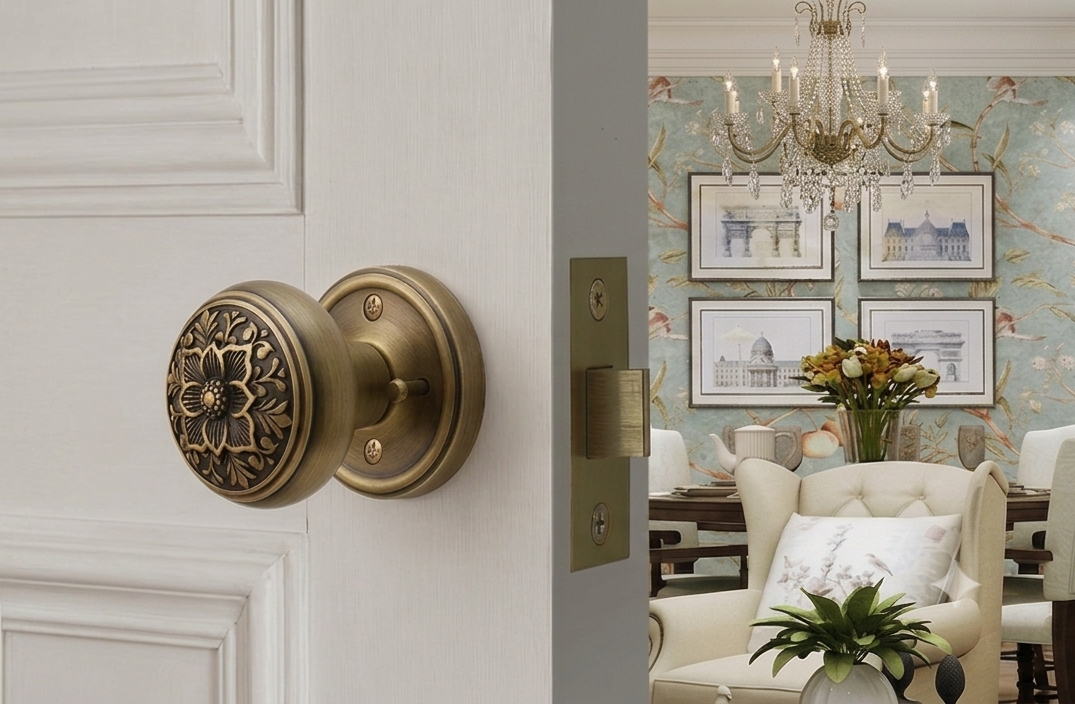
In Georgian, Victorian, and Edwardian styles, as well as in vintage manor cottages, door knobs are often the perfect finishing touch that captures the essence of an era. In period restorations or antique-inspired designs, Floral Pattern Door Knobs stand as a timeless icon. Signature pieces from FLIRABBIT feature intricate and delicate floral reliefs—such as roses and scrolling vines—cast in heavy solid brass to recreate 18th- and 19th-century European garden aesthetics.
The surfaces feature intricate and delicate floral reliefs—such as roses, honeysuckle, irises, and scrolling vines—with rich, three-dimensional textures that recreate 18th- and 19th-century European garden aesthetics. Whether crafted from intricately carved solid wood or cast in vintage brass, they instantly infuse a space with a classic, romantic ambiance, fully restoring the elegant grandeur of historic estate mansions.
When renovating historic properties, it is essential to carefully inspect the traces left by original hardware, such as paint shadows, old screw holes, or filled-in mortice slots. In many cases, retaining or restoring a split-rose door lock configuration equipped with matching floral-carved accessories and a privacy locking pin is far more elegant and protective of the heritage structure than forcing a new, large mortice pocket into old wooden doors that have become weathered and brittle over time. Furthermore, using a cohesive set of floral-patterned hardware to unify the design of the door knobs, lock plates, and hinges significantly enhances the stylistic integrity of a vintage space.


IX.Frequently Asked Questions (FAQ)
Q1: What is the fundamental difference between a door knob and a lever handle?
A: The difference lies primarily in the operation style and user accessibility. A door knob requires palm grip strength and a twisting motion, yielding a classic, decorative, and highly aesthetic look. A lever handle utilizes a lever mechanism, meaning it can be opened with a simple downward push—making it much more user-friendly for toddlers, the elderly, or anyone with full hands.
Q2: Can I directly replace a standard lever handle with a round door knob?
A: Yes, but you must strictly check the existing lock body and backset. If your current latch backset is too short (less than 64mm), switching to a spherical knob will almost certainly result in scraped knuckles. You will likely need to fill the old holes, recut the mortice slot, and install a new lock body with a longer backset.
Q3: Are unsprung knobs indicative of poor quality?
A: Absolutely not. On the contrary, many of the most premium, authentic historical reproductions in heavy solid brass or dense hardwoods are unsprung to maintain their exact historical profile. The key to their longevity is pairing them with a high-quality, heavy-duty mortice lock body equipped with a powerful internal return spring.
Q4: Can door knobs be used on front doors or exterior doors?
A: Yes, they can. However, keep two things in mind: first, the knob itself does not provide security—the entrance door must be equipped with certified, high-security deadlocks; second, the material must be weather-resistant. Exterior doors should feature solid brass, bronze, or stainless steel, while wood or untreated cast iron should be avoided to prevent weathering or rust.
Q5: How do I choose between a Privacy Pin door knob and a traditional bathroom mortice lock?
A: This comes down to your installation complexity and aesthetic style preferences. A traditional bathroom lock requires a separate thumbturn and release, meaning your door face must be drilled twice (once for the knob, once for the turnpiece), leaning towards a classic, traditional aesthetic. Conversely, a Privacy Pin door knob cleanly unifies both functions. It requires only a single standard bore hole during installation, making it highly efficient to fit, while delivering the ultra-clean, minimalist look preferred in high-end modern luxury and contemporary homes.

Leave a comment
This site is protected by hCaptcha and the hCaptcha Privacy Policy and Terms of Service apply.